In the vibrant world of elementary education, every moment is a learning opportunity, and every interaction with a child holds valuable insights. Capturing these fleeting observations effectively is crucial for understanding student progress, behaviors, and individual needs. That’s where an anecdotal record template for elementary comes in, serving as an indispensable tool for teachers to document specific events and observations in a structured, meaningful way.

Imagine being able to easily recall a specific instance of a student demonstrating a new skill, struggling with a concept, or showing remarkable kindness to a peer. These aren’t just isolated moments; they are data points that, when collected systematically, paint a comprehensive picture of a child’s development. Without a clear system, these observations can easily be forgotten or become muddled over time.
This article will guide you through the significance of anecdotal records in the elementary classroom and show you how to create and utilize effective templates that empower you to support your students more thoughtfully and communicate their progress with greater clarity to parents and colleagues alike.
Understanding the Power of Anecdotal Records in Elementary Classrooms
Anecdotal records are essentially brief, objective descriptions of an event or behavior that is significant to a student’s learning or development. Think of them as snapshots – specific, factual accounts of what a child said or did, how they interacted, or what they accomplished in a particular context. In elementary settings, these records are particularly potent because they capture the nuances of growth that standardized tests often miss.
The benefits of maintaining these records are vast. They provide concrete evidence for student progress, help identify patterns in behavior or learning styles, and offer invaluable insights for differentiating instruction. When you sit down for a parent-teacher conference, having specific, dated examples of a child’s strengths or areas for growth is far more impactful than vague generalizations. They transform subjective impressions into objective data points.
What makes a good anecdotal record? It needs to be objective, specific, and timely. An objective record focuses on observable actions and words, avoiding interpretations or judgments in the initial description. For example, instead of writing “Sarah was disruptive,” an objective record would state, “Sarah repeatedly tapped her pencil on the desk during silent reading time and whispered to the student next to her.”
To observe effectively, elementary teachers need to develop a keen eye for significant moments. This doesn’t mean stopping teaching to write a novel; rather, it’s about making mental notes during an activity and quickly jotting down key details as soon as possible after the event. Look for instances that highlight a new understanding, a persistent challenge, a social interaction, or a particular emotional response.
Knowing when to record is just as important. It could be during independent work, group activities, recess, or even transitions between subjects. Regular, consistent recording helps build a richer profile over time, allowing you to track development and intervention effectiveness. These records aren’t just for problematic behaviors; they’re equally vital for celebrating achievements and recognizing positive strides.
Unlike formal assessments or checklists, anecdotal records offer a narrative account that captures the richness and complexity of a child’s learning journey. They complement other assessment tools by providing the story behind the data, helping educators understand the ‘why’ and ‘how’ of student performance, leading to more informed educational decisions and a more personalized approach to teaching.
Key Elements of an Effective Anecdotal Record
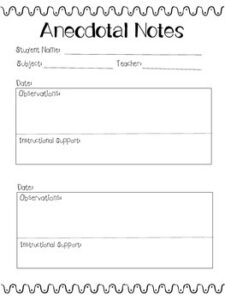
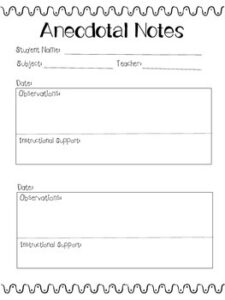
For an anecdotal record to be truly useful, it should contain several core pieces of information. This typically includes the date and time of the observation, the student’s name, the observer’s name, the context or setting in which the observation occurred, the objective description of what happened, and finally, your interpretation or any follow-up actions planned. Having these consistent fields ensures that your records are comprehensive and easy to reference later.
Why Specificity Matters
The power of an anecdotal record lies in its specificity. General statements like “He struggled with math” are far less helpful than “During the subtraction lesson, John consistently confused the tens and ones places when regrouping, specifically when solving 34 – 17, stating ’14 minus 7 is 7, and 3 minus 1 is 2, so 27′.” This level of detail allows you to pinpoint exact areas of need and tailor your support accordingly.
Crafting Your Own Anecdotal Record Template
Now that you understand the immense value, let’s talk practicalities: designing an anecdotal record template for elementary use that truly works for you. A well-designed template simplifies the recording process, making it less of a chore and more of an intuitive habit. The goal is to create something easy to use, whether you prefer a digital document or a physical clipboard.
When creating your template, think about the information you consistently need to capture. While the basic elements are standard, you might want to add fields specific to your classroom or curriculum. For example, some teachers include a section for the learning domain (e.g., ELA, Math, Social-Emotional) or a rating scale for the intensity of a behavior.
Consider the format that best suits your teaching style and classroom environment. A simple table in a notebook, a printed sheet to slip onto a clipboard, or a digital form on a tablet can all be effective. The best template is one you’ll actually use consistently. Make it easy to access and quick to fill out, so it doesn’t interrupt the flow of your teaching.
- Date and Time of Observation
- Student’s Name(s)
- Observer’s Name
- Context/Setting (e.g., “during group reading,” “at recess,” “independent math work”)
- Objective Observation (What was seen/heard, factual description)
- Teacher’s Interpretation/Analysis (What does this observation suggest?)
- Follow-up Action/Next Steps (e.g., “model regrouping again,” “check in with student at lunch,” “communicate with parents”)
Remember, your anecdotal record template for elementary should be a living document that you can adapt over time. As you use it, you’ll discover what works best and what might need tweaking. The key is to start, gather those precious observations, and use them to nurture every child’s potential.
Implementing a systematic approach to anecdotal records provides a rich tapestry of information about your students. It transforms isolated moments into a coherent narrative of each child’s growth, challenges, and triumphs. This detailed understanding allows for more targeted interventions, celebratory acknowledgments, and genuinely personalized education, fostering a learning environment where every student feels seen and supported.
By consistently capturing these invaluable insights, you build a powerful resource that informs your teaching, strengthens your communication with families, and ultimately contributes to a more effective and compassionate elementary classroom. Embrace the power of observation, and watch how it deepens your understanding and impact as an educator.