Navigating the world with an emotional support animal (ESA) brings immense comfort and aid, but it also requires proper documentation. A well-prepared emotional support dog letter is your key to ensuring your furry companion can accompany you where legally allowed, particularly in housing situations. This crucial document verifies your need for an ESA, making the process smoother for both you and property managers. Understanding what makes an ESA letter valid and having an accessible emotional support dog letter template can save you time and stress. This article will guide you through the essential components of such a letter, clarify who can issue it, and provide a clear sample to help you prepare. By the end, you’ll have a firm grasp of the requirements for official ESA documentation.
Understanding the Essential Emotional Support Dog Letter Template
A legitimate emotional support animal letter serves as official proof that your dog is an integral part of your mental health treatment. This document, often referred to as an ESA letter or prescription, is not merely a formality; it’s a legal safeguard under federal laws like the Fair Housing Act. It clearly states your need for an animal companion to mitigate symptoms of a recognized mental health disability.
The most critical aspect of this official documentation is that it must come from a licensed mental health professional (LMHP). This includes psychiatrists, psychologists, licensed clinical social workers, and other licensed therapists. They must have an established therapeutic relationship with you and be qualified to assess your mental health condition. Without a professional’s endorsement, your emotional support animal documentation may not be recognized.
Who Can Issue an Emotional Support Animal Letter?
Only a licensed mental health professional can provide a valid emotional support dog letter. This individual must be licensed in the state where they practice and where you receive treatment. It’s vital that they genuinely understand your specific needs and can attest to how an emotional support animal alleviates symptoms of your condition.
Be wary of websites offering instant ESA letters without a proper consultation or therapeutic relationship. Such letters are often not considered legitimate and may lead to issues with housing providers. Always prioritize a genuine assessment from a healthcare provider you trust. Ensuring your letter comes from a qualified source is the first step towards proper accommodation.
Key Components of a Valid ESA Letter
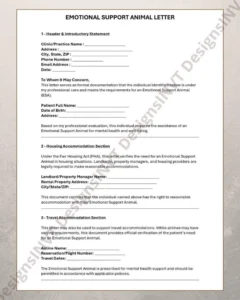
A comprehensive emotional support dog letter template should include several vital pieces of information to be legally sound and widely accepted. Each element plays a role in establishing the legitimacy of your need for an ESA. Missing even one detail can lead to complications, so attention to detail is paramount.  Here are the essential elements typically found in a well-structured ESA letter:
- Professional Letterhead: The document should be printed on the official letterhead of the licensed mental health professional. This adds immediate credibility and professional appearance.
- Date of Issuance: Clearly state the date the letter was written. Some entities may require a recent letter, typically within the last year.
- Patient’s Name: Your full legal name must be explicitly stated, confirming you are the patient under the professional’s care.
- Professional’s License Information: The LMHP’s full name, title, license number, and state of licensure are essential. This allows for verification of their credentials.
- Statement of Disability: The letter must confirm that you have a mental or emotional disability that significantly impacts a major life activity. It does not need to disclose your specific diagnosis.
- Need for ESA: The professional must state that the emotional support dog is necessary for your mental health and well-being. They should explain how the animal mitigates the symptoms of your disability.
- Type of Animal (Optional but Recommended): While not strictly required by law, specifying that the animal is a “dog” can be helpful for clarity, especially when utilizing an emotional support dog letter template.
- Signature: The original signature of the licensed mental health professional is crucial for authenticity.
- Contact Information: Include the LMHP’s full contact details, including phone number and address, for potential verification (though verification should only confirm the validity of the letter, not specific diagnoses).
Sample Emotional Support Dog Letter Template
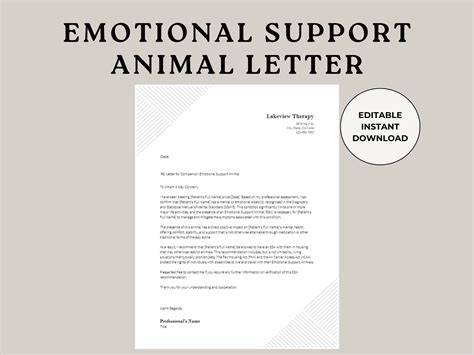
Using a clear and concise emotional support dog letter template can help ensure all necessary information is included. This sample provides a framework that you can adapt with your specific details and those of your licensed mental health professional. Remember, this is a guide, and your professional will draft the official document.
[Your LMHP’s Official Letterhead]
[LMHP’s Name, Title]
[LMHP’s License Number, State of Licensure]
[LMHP’s Address]
[LMHP’s Phone Number]
[LMHP’s Email Address]
[Date]
To Whom It May Concern,
I am writing this letter on behalf of my patient, [Your Full Legal Name], born [Your Date of Birth]. I am a licensed mental health professional in the state of [State Name], and I have been providing therapeutic care for [Your Full Legal Name] since [Date of First Consultation].
Based on my professional assessment and evaluation, [Your Full Legal Name] has a recognized mental or emotional disability under the Diagnostic and Statistical Manual of Mental Disorders (DSM-5). This condition significantly impacts one or more major life activities.
It is my professional opinion that an emotional support animal is a necessary accommodation for [Your Full Legal Name]’s mental health and stability. Their emotional support dog, [Dog’s Name], provides therapeutic benefits that mitigate the symptoms of their disability.
Specifically, the presence of [Dog’s Name] provides comfort, reduces anxiety, and helps to stabilize [Your Full Legal Name]’s emotional state, thereby allowing them to function more effectively in daily life. This animal is essential for their emotional well-being and is part of their ongoing treatment plan.
Therefore, I prescribe [Your Full Legal Name] to have their emotional support dog as a reasonable accommodation in housing, consistent with the Fair Housing Act and other applicable federal laws. Please feel free to contact me if you require verification of my license; however, I cannot disclose specific patient diagnostic information due to confidentiality laws.
Thank you for your understanding and cooperation in providing this essential accommodation.
Sincerely,
[LMHP’s Signature]
[Typed Name of LMHP]
[Title]
Obtaining a legitimate emotional support dog letter is a crucial step for individuals relying on their animal companions for mental health support. This document is not just a piece of paper; it’s an affirmation of your medical need and a gateway to reasonable accommodations. By understanding its components and using a reliable emotional support dog letter template, you empower yourself to navigate housing and other situations with confidence and legal backing.
Always remember that the validity of your ESA letter hinges on it being issued by a licensed mental health professional with whom you have an established therapeutic relationship. Prioritize your mental health by seeking proper care and ensuring all your documentation, including an emotional support dog letter, is accurate and compliant. This proactive approach will help you and your beloved ESA live together harmoniously.