Closing a business, whether a small retail shop or a large corporation, is a significant decision. Communicating this change professionally and clearly is crucial for maintaining your reputation and fulfilling legal obligations. A well-crafted going out of business letter template ensures you cover all necessary points, inform stakeholders effectively, and manage the transition smoothly. This guide provides a comprehensive framework and sample to help you navigate this sensitive process.
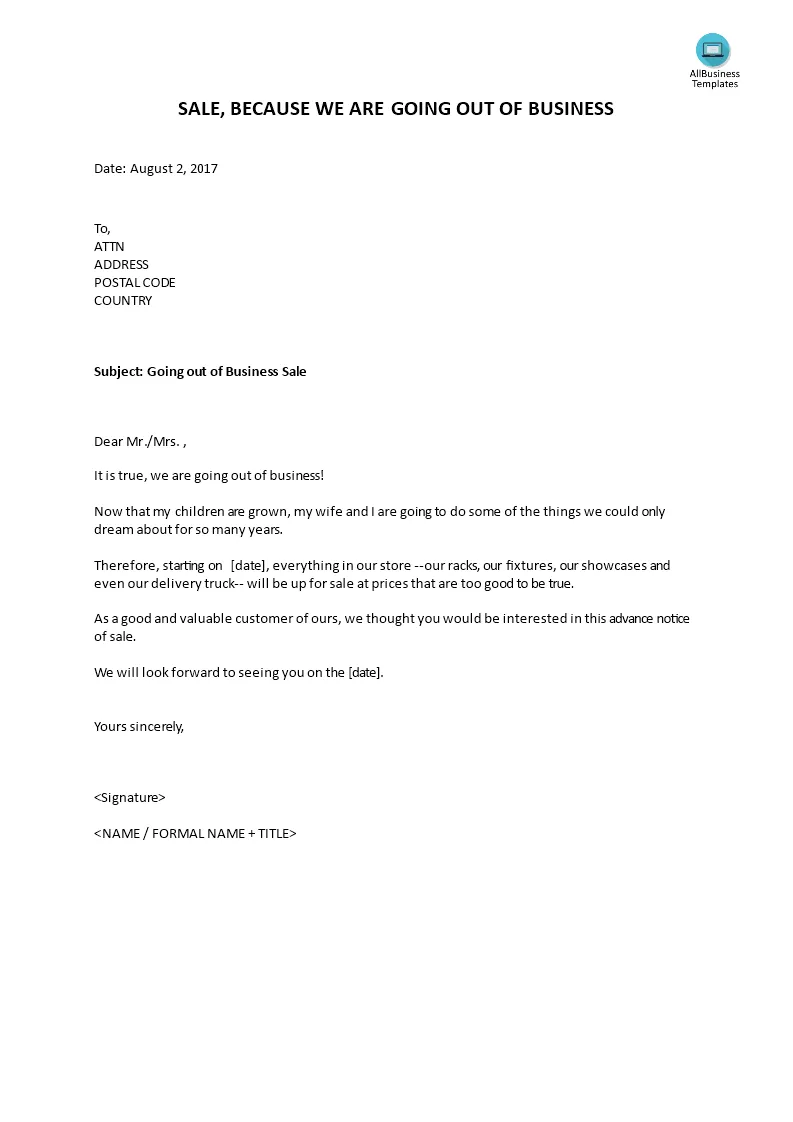

Utilizing a reliable business closure notice helps prevent misunderstandings and legal issues, allowing for a respectful and organized wind-down. You will learn about the essential elements of such a letter, best practices for its distribution, and gain access to a ready-to-use template. This resource is designed for professionals, property managers, tenants, and employers seeking a legally sound communication tool.
Crafting Your Business Closure Notice: Key Elements and Best Practices
Issuing a formal business closure notice is more than a courtesy; it’s a vital part of responsible business practice. Proper communication protects your brand image and ensures compliance with contractual and legal requirements. Failing to notify customers, suppliers, or employees promptly can lead to significant complications and negative repercussions.
A robust going out of business letter template must include several critical pieces of information. It should clearly state the effective date of closure, which allows recipients to plan accordingly. Transparency in communication builds trust, even during a challenging period for your business. This careful approach helps maintain good relationships for future endeavors.
Consider the various audiences who need to receive this communication. Customers require information about final sales, warranty claims, or product returns. Employees need details regarding their final work dates, benefits, and severance packages. Vendors and suppliers need to know about outstanding invoices and contract terminations.
Here are the essential components to include in your business closure notice:
- Official Business Name and Contact Information: Clearly state who the letter is from.
- Date of Letter: Indicates when the announcement is made.
- Recipient’s Name and Address: Personalize the letter where possible.
- Clear Statement of Closure: Unequivocally announce the business is closing.
- Effective Date of Closure: Specify the exact date operations will cease.
- Reason for Closure (Optional but Recommended): A brief, professional explanation can prevent speculation.
- Instructions for Customers: Details on final sales, refunds, or service completion.
- Instructions for Vendors/Suppliers: Information regarding outstanding payments or contract termination.
- Instructions for Employees: Guidance on final paychecks, benefits, and job search support.
- Contact Person for Questions: Provide a designated individual or department for inquiries.
- Professional Closing: Maintain a formal and respectful tone.
Sample Going Out Of Business Letter Template
Here is a simplified structure for a going out of business letter template. Remember to customize it fully to fit your specific situation and legal requirements. This example serves as a strong starting point for various business types.
[Your Company Letterhead/Logo]
[Date]
[Recipient Name/Department or “To Our Valued Customers/Partners/Employees”] [Recipient Title] [Recipient Organization] [Recipient Address]
Subject: Important Announcement Regarding [Your Company Name]’s Closure
Dear [Recipient Name or appropriate salutation],
It is with sincere regret that we announce the official closure of [Your Company Name], effective [Date of Closure]. This decision comes after careful consideration and is due to [brief, professional reason for closure, e.g., “the current economic climate,” “strategic restructuring,” “retirement of the owner”].
We extend our deepest gratitude for your [loyalty as a customer/partnership as a vendor/dedication as an employee] over the years. Your support has been invaluable to us.
For Customers: All [products/services] will be available until [Last Day of Service/Sale]. Please visit [Website/Store Location] for our final [sales/clearance offers]. Any outstanding [orders/warranty claims] will be honored until [Specific Date]. For inquiries, please contact [Contact Method, e.g., email address or phone number] before [Date].
For Vendors/Suppliers: We are committed to settling all outstanding invoices by [Specific Date]. Please ensure all final statements are submitted to [Email Address/Department] by [Submission Deadline]. For any contractual questions, please reach out to [Contact Person/Department] at [Contact Information].
For Employees: We will be holding individual meetings to discuss your final employment details, including final paychecks, accrued benefits, and severance packages, if applicable. Support for job placement and references will be provided. Please contact [HR Department/Manager Name] to schedule your meeting.
We understand this news may cause inconvenience, and we sincerely apologize for any disruption. We appreciate your understanding and cooperation during this transition period.
Sincerely,
[Your Name] [Your Title] [Your Company Name] [Your Contact Information]
Navigating Legal and Ethical Considerations for Business Closure
Beyond the basic announcement, a comprehensive business closure involves several legal and ethical responsibilities. Notice periods for employees, tenants, and contractual partners are often mandated by law or existing agreements. Neglecting these can result in legal challenges, fines, and damage to your professional standing. Consulting with legal counsel is highly recommended to ensure full compliance with local, state, and federal regulations applicable to your specific industry and location.
Ethical considerations play a crucial role in how your business is remembered. Providing adequate notice and support to employees, for instance, reflects positively on your leadership and commitment to your team. Likewise, ensuring customer obligations are met, such as processing refunds or completing services, safeguards your brand’s integrity even as it closes. Prioritizing clear, consistent, and compassionate communication minimizes stress for all parties involved.
The responsible dissemination of your business closure notice is just as important as its content. Depending on the recipient, this may involve certified mail for formal contractual notices, email blasts for customers, or in-person meetings for employees. Tailoring your communication channel to the audience ensures your message is received promptly and with the appropriate level of formality.
Effectively managing a business closure requires careful planning and precise communication. Utilizing a comprehensive going out of business letter template serves as a vital tool in this process. It helps ensure all necessary information is conveyed clearly and professionally to every stakeholder, from customers and employees to landlords and suppliers. This proactive approach minimizes confusion and allows for a dignified wind-down of operations, protecting your legacy and future opportunities.
Remember, while a template provides a solid foundation, each business closure is unique. Always customize the language, include specific details relevant to your situation, and consider seeking legal advice to ensure full compliance with all applicable laws and regulations. A smooth transition is achievable with thoughtful preparation and clear, consistent communication.