In the professional world, maintaining strong relationships often means going the extra mile. Sometimes, an unforeseen issue arises, a service falls short, or a misunderstanding occurs. In these moments, a well-crafted communication can bridge the gap, rebuild trust, and even strengthen connections. This is precisely where a thoughtful gesture of goodwill letter template becomes an invaluable tool for any professional, property manager, or individual.  Understanding how to properly convey sincerity and offer a meaningful resolution is crucial for effective administrative writing and professional communication. This article will guide you through the process of creating such a document, provide a ready-to-use gesture of goodwill letter template, and explain why mastering this skill is essential for conflict resolution and fostering positive relationships. You’ll learn the key components and best practices to ensure your message hits the right tone.
Understanding the Purpose of a Goodwill Letter
A goodwill letter serves as a formal acknowledgment of a problem or inconvenience, often accompanied by an offer of a solution or compensation. It’s not always an admission of fault, but rather a proactive step to show empathy and maintain a positive relationship. These letters are powerful tools for customer retention, dispute resolution, and generally enhancing your reputation.
For businesses, sending a goodwill letter can prevent negative reviews, resolve potential legal disputes, and retain valuable customers. Property managers might use them to address tenant concerns, while employers could utilize them for employee relations. The goal is always to defuse tension and move towards a satisfactory outcome for all parties involved, demonstrating a commitment to excellent service or fair dealings.
Key Elements of a Professional Goodwill Letter
Crafting an effective goodwill letter requires careful consideration of several core components. Each part plays a vital role in conveying your message clearly, professionally, and empathetically. A good gesture of goodwill letter template will incorporate these elements to ensure completeness and impact.
- Sender’s Information: Clearly state your name, title, organization, address, and contact details. This ensures the recipient knows who is communicating with them.
- Date: Include the precise date the letter is being sent. This is standard for all formal business correspondence.
- Recipient’s Information: Address the letter directly to the individual or organization concerned. Accuracy here is paramount for proper delivery.
- Salutation: Use a formal and respectful salutation, such as “Dear Mr./Ms./Mx. [Last Name]” or “Dear [Company Name] Representative.”
- Opening Statement: Briefly and directly state the purpose of the letter, referencing the specific issue or incident. Acknowledge the recipient’s experience without necessarily accepting blame.
- Acknowledge the Problem: Demonstrate understanding and empathy regarding the situation. Show that you have listened or reviewed the issue thoroughly.
- Offer a Solution/Gesture: Propose a specific, tangible gesture of goodwill. This could be a discount, a refund, a credit, an extended service, or a direct apology for inconvenience.
- Justification (Optional): Briefly explain why this gesture is being made, linking it to your commitment to service or relationship.
- Closing Statement: Reiterate your commitment to positive relations and express hope for continued engagement.
- Professional Closing: Use a formal closing like “Sincerely,” “Regards,” or “Best regards.”
- Signature: Your handwritten signature (if a physical letter) followed by your typed name and title.
By including these key elements, your letter will be comprehensive and professional. Remember, the tone should always be respectful and focused on resolution. This structured approach helps ensure no critical information is missed, making your gesture of goodwill truly effective.
Sample Gesture of Goodwill Letter Template
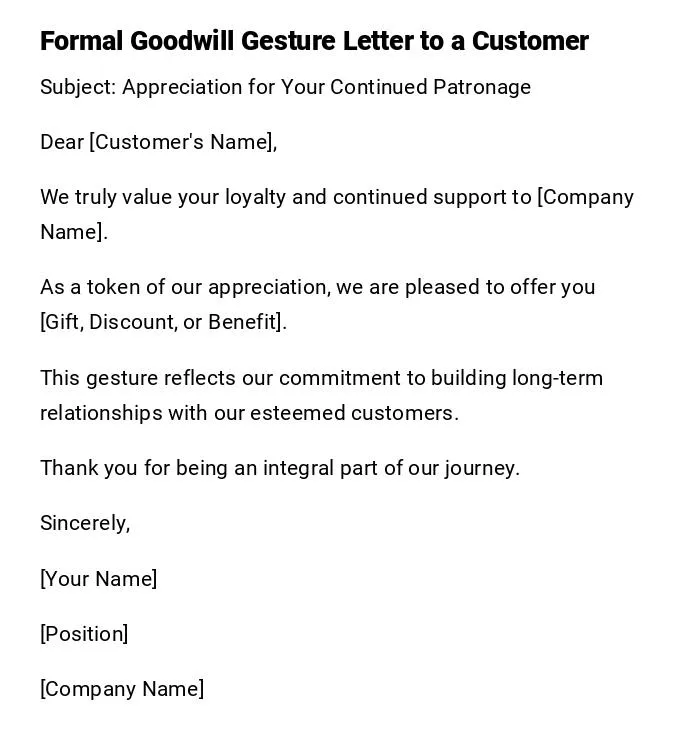
Here is a customizable gesture of goodwill letter template that you can adapt for various situations, whether you’re a property manager addressing a tenant, an employer communicating with an employee, or a business reaching out to a customer. Remember to personalize the bracketed information to fit your specific circumstances. This template provides a strong foundation for your communication.
[Your Name/Company Name]
[Your Address]
[Your City, State, Zip Code]
[Your Phone Number]
[Your Email Address]

[Date]

[Recipient Name]
[Recipient Address]
[Recipient City, State, Zip Code]

Dear [Mr./Ms./Mx. Last Name or Valued Customer/Tenant/Employee],

Please accept this letter regarding the recent [briefly describe the issue, e.g., "service disruption," "misunderstanding regarding X," "delay in delivery of Y"]. We understand this caused [describe impact, e.g., "inconvenience," "frustration," "a negative experience"]. We sincerely regret any difficulties or dissatisfaction this situation may have caused you.

Our commitment is to provide excellent [service/support/living conditions]. We value your [business/tenancy/contribution] and want to ensure your continued satisfaction. Upon reviewing the circumstances, we acknowledge that our [system/process/communication] did not meet the expected standards in this instance, or that external factors created an unforeseen challenge.

As a gesture of goodwill, we would like to offer you [clearly state the gesture, e.g., "a 10% discount on your next service," "a complimentary month of X," "a full refund for Y," "an expedited resolution to the outstanding matter," "a credit of $Z towards your next invoice"]. We hope this helps to mitigate the impact of the inconvenience you experienced.

We are actively working to [describe preventive measures, e.g., "improve our procedures," "train our staff further," "enhance our communication channels"] to prevent similar issues in the future. We truly appreciate your understanding and patience as we strive for continuous improvement.

Thank you for your continued [patronage/tenancy/service]. We look forward to rebuilding your trust and providing you with the high-quality experience you deserve.

Sincerely,

[Your Signature (if printed)]

[Your Typed Name]
[Your Title]
This template is designed to be flexible. For instance, a property manager might offer a rent abatement, while an employer might offer an additional day of paid leave. The crucial aspect is that the gesture is meaningful and appropriate to the situation and the relationship. Using this gesture of goodwill letter template can save time and ensure professional communication. Always review and edit your letter carefully before sending it. Proofread for any grammatical errors or typos, and ensure the tone is just right.
A well-written letter can make a significant difference in how your gesture is received and appreciated, solidifying positive relationships for the long term. In conclusion, mastering the art of the goodwill letter is a powerful asset in both personal and professional spheres. By utilizing a clear, empathetic, and resolution-focused approach, you can transform potentially negative situations into opportunities for strengthened relationships and improved trust.
A carefully composed gesture of goodwill letter template, like the one provided, empowers you to communicate effectively and proactively address concerns, ultimately fostering a positive environment. Remember, the goal is not just to fix a problem, but to reinforce your commitment to the individual or entity involved.
Take the time to personalize your message and offer a truly meaningful gesture. By doing so, you can ensure your communication leaves a lasting positive impression, encourages continued engagement, and solidifies your reputation as someone who prioritizes fairness and respect. Utilize this knowledge to build stronger connections in all your dealings.