Managing a workforce that operates around the clock can be quite a puzzle, especially when you need to ensure continuous coverage without burning out your team. Twelve-hour shifts are a common solution for many industries, from manufacturing and healthcare to emergency services, offering benefits like fewer handovers and longer blocks of time off. However, getting the rotation right for a four-crew system requires careful planning and a clear understanding of various factors.
The goal isn’t just to fill the shifts; it’s about creating a sustainable pattern that supports both operational efficiency and employee well-being. A well-designed 4 crew 12 hour shift schedule template can be a game-changer, providing predictability for your staff, reducing administrative headaches, and helping to maintain consistent productivity. Let’s dive into how these schedules work and how you can craft one that truly makes a difference.
Understanding the Core of a 4 Crew 12 Hour Shift Schedule
Twelve-hour shifts are often preferred in environments requiring 24/7 operation because they simplify handovers between shifts and allow employees to have more consecutive days off. This structure can lead to a better work-life balance for staff, as the longer breaks can be used for appointments, family time, or simply recharging. For the organization, it often means fewer instances of needing to hire additional staff just to cover odd hours, as the system inherently provides comprehensive coverage.
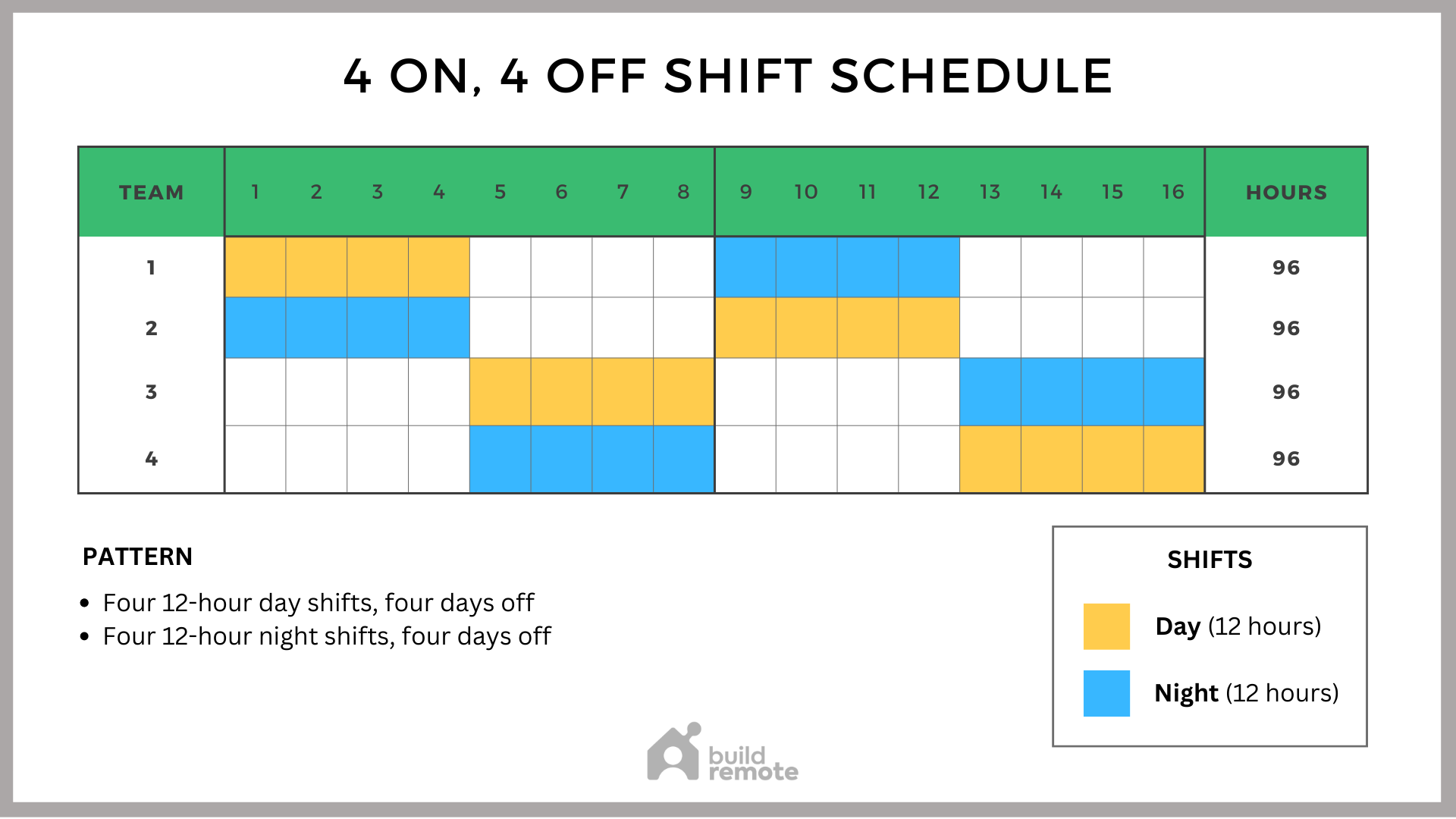
When we talk about a “4 crew” system, we’re typically referring to a setup where you have four distinct teams of employees who rotate through the 12-hour shifts. The beauty of having four crews is that it allows for continuous coverage while ensuring that each crew gets ample time off. This usually involves a pattern where two crews are working at any given time (one on day shift, one on night shift), while the other two crews are off. Over a specific cycle, all four crews will rotate through the working and non-working periods.
Several popular rotation patterns have emerged over time, each with its own advantages. The choice of pattern often depends on the specific demands of the operation and the preferences of the workforce. Understanding these common structures is the first step toward building an effective schedule.
Popular 4 Crew 12-Hour Rotations
- The Pitman Schedule (or 2-3-2 Rotation): This is perhaps one of the most widely used 4 crew 12-hour shift schedules. It involves a 2-day on, 2-day off, 3-day on, 2-day off, 2-day on, 3-day off pattern over a 28-day cycle. This means employees work two consecutive day shifts, get two days off, then work three consecutive day shifts, followed by two days off, then two day shifts, then three days off. After this, they switch to the night shift rotation following a similar pattern. This schedule is popular because it provides every other weekend off and offers a relatively balanced work-to-rest ratio.
- The DuPont Schedule: While often more complex, this schedule involves a 4-on, 3-off, 3-on, 1-off, 3-on, 4-off, 7-on, 3-off pattern, usually covering an 8-week cycle. It results in longer blocks of time off, but also longer working stretches, which some find appealing while others find challenging.
- Modified Schedules: Many organizations adapt these core patterns to better suit their unique operational needs or to comply with specific labor laws. The key is to maintain the fundamental balance of work and rest that a 4-crew system is designed to provide.
Designing Your Own 4 Crew 12 Hour Shift Schedule Template
Creating a truly effective 4 crew 12 hour shift schedule template isn’t just about picking a pattern and plugging in names; it’s about tailoring it to your specific environment. Every workplace has its own rhythm, its own peak times, and its own regulatory requirements. Therefore, while a generic template can be a starting point, the most successful schedules are those that have been customized to reflect these unique circumstances. Consider your operational demands, the number of staff required per shift, and any legal stipulations regarding breaks and consecutive working hours.
Before you even start assigning shifts, it’s crucial to map out your core requirements. How many people do you need on a day shift versus a night shift? Are there certain days of the week or times of the month that require more personnel? Understanding these variables will help you choose or modify a rotation pattern that truly fits. Don’t forget to account for holidays, training days, and potential sick leave, building in a degree of flexibility or backup coverage into your plan.
Once you have a clear picture of your staffing needs, you can begin to overlay a chosen 4 crew 12-hour rotation pattern. Start by defining your day and night shifts, including their exact start and end times. Then, allocate your four crews to follow the chosen rotation, ensuring that there’s always a day crew and a night crew working, while the other two crews are off. Visualizing this on a calendar or spreadsheet can be immensely helpful in identifying any gaps or overlaps.
Remember that a great schedule isn’t static; it often requires a bit of fine-tuning after implementation. Gather feedback from your employees. Are they finding the rotations manageable? Are the breaks adequate? While you can’t please everyone, incorporating feedback where possible can significantly boost morale and adherence to the schedule. Tools ranging from simple spreadsheets to dedicated shift scheduling software can assist in managing these complex rotations, but the underlying principles remain the same. The ultimate goal of any 4 crew 12 hour shift schedule template is to ensure seamless operation while prioritizing the health and productivity of your team.
Implementing a well-thought-out 4 crew 12 hour shift schedule is more than just an administrative task; it’s a strategic move that can dramatically impact an organization’s efficiency and employee satisfaction. By providing a clear, predictable rhythm for work and rest, these schedules foster a healthier work environment, reduce fatigue, and ultimately contribute to higher quality output and service delivery. It demonstrates a commitment to both operational excellence and staff well-being, creating a win-win situation for everyone involved.
Taking the time to research, design, and refine your shift schedule will pay dividends in the long run. It ensures that your critical operations never falter due to staffing issues and that your team feels supported and valued. A robust scheduling system is a cornerstone of sustainable continuous operations, setting the stage for consistent performance and a positive workplace culture.