Planning a baseball season for multiple teams can feel like a complex puzzle, especially when you’re aiming for fairness, efficiency, and plenty of exciting games. Whether you’re managing a local youth league, an adult recreational league, or even a small professional circuit, getting the schedule right from the start is absolutely crucial for a smooth and enjoyable experience for everyone involved. It’s not just about listing games; it’s about strategic placement that considers bye weeks, travel, and equal opportunities.

If you’ve ever found yourself scratching your head trying to figure out how to perfectly balance games for five teams, you’re definitely not alone. The unique number of teams, an odd figure, presents its own set of challenges that a simple round-robin might not immediately solve. But don’t worry, creating an effective and equitable schedule is entirely achievable. This guide is designed to walk you through the process, helping you develop a robust 5 team baseball schedule template that works for your league.
Understanding the Challenge of Scheduling Five Teams
When you’re dealing with five teams, the primary hurdle immediately becomes apparent: someone always has a bye week. In any given round of games, if four teams are playing, one team must sit out. This isn’t necessarily a bad thing, as a well-managed bye week can be a welcome break or an opportunity for practice, but it absolutely needs to be factored into your schedule design to ensure fairness over the entire season. The goal is to rotate these bye weeks so no single team feels disadvantaged or gets too many long breaks between games.
Another significant consideration is ensuring each team plays every other team an equal number of times, or at least as equally as possible, especially if you’re aiming for a true round-robin format. For a five-team league, a single round-robin means each team plays four games, one against each opponent. To get more games, you’ll likely want to play multiple rounds. This multiplies the complexity, as you’ll also need to consider home and away designations, if applicable, or simply which team is designated as the "home" team for scorekeeping purposes on a neutral field.
The odd number of teams also means that traditional pairing methods need a slight adjustment. You can’t simply divide five by two. Instead, you’ll always be looking at pairs of games, with one team left over. This makes the rotation key. A fair schedule ensures that over the course of the season, each team not only gets their turn for a bye but also experiences a variety of opponents at different times, rather than constantly playing the same teams in early rounds.
Developing a robust 5 team baseball schedule template means anticipating these quirks and building a framework that addresses them proactively. It’s about more than just filling slots on a calendar; it’s about strategic planning that contributes to a more competitive and enjoyable league environment. A well-designed schedule helps prevent disputes, ensures equal playing opportunities, and ultimately makes your job as an organizer much easier.
Key Principles for a Fair 5 Team Schedule
To build a successful schedule, keep these fundamental principles in mind:
- **Equal Opposition:** Ensure every team plays every other team the same number of times over the season.
- **Bye Week Rotation:** Distribute bye weeks evenly among all five teams throughout the league’s duration. No team should have an excessive number of bye weeks early or late in the season without justification.
- **Game Distribution:** Aim for a consistent number of games per week for the teams that are playing, avoiding back-to-back games for the same team if possible, unless field availability dictates otherwise.
- **Field and Time Slot Consistency (if applicable):** If you have limited fields or preferred time slots, try to rotate teams through them so no team is always stuck with the earliest or latest game.
By adhering to these principles, you lay the groundwork for a truly equitable and manageable baseball season for your five-team league.
Crafting Your Own 5 Team Baseball Schedule Template
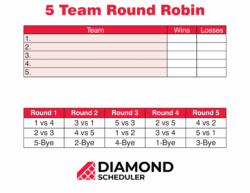
Now that we’ve explored the challenges, let’s dive into practical steps for creating your very own 5 team baseball schedule template. The most common and effective method for an odd number of teams is often referred to as the “Circle Method” or “Rotation Method.” Imagine your teams numbered 1 through 5. You fix one team (say, Team 1) in place, and then rotate the other teams clockwise around it. For each round, Team 1 plays the team opposite it, and the remaining teams pair off. The team that ends up without an opponent gets the bye.
Let’s illustrate this with a simple structure. In a five-team league (Teams A, B, C, D, E), a single round-robin would consist of five distinct weeks or rounds, with each team getting one bye.
Here’s how a basic round-robin might look over five weeks:
- Week 1: Team A vs. Team E, Team B vs. Team D, Team C has a bye.
- Week 2: Team E vs. Team D, Team A vs. Team C, Team B has a bye.
- Week 3: Team D vs. Team C, Team E vs. Team B, Team A has a bye.
- Week 4: Team C vs. Team B, Team D vs. Team A, Team E has a bye.
- Week 5: Team B vs. Team A, Team C vs. Team E, Team D has a bye.
This initial framework ensures everyone plays everyone once and gets a bye. If you need more games, simply repeat these five weeks, perhaps reversing home/away designations for a second round-robin, or adding a third round-robin for a total of 12 games per team (plus three bye weeks each across the three rounds). The key is to keep track of who played whom and when.
When you’re building out your template, think about the practicalities beyond just pairings. Consider your available playing days and times. Do you have one field or multiple? Are certain days of the week better for your players? Are there any holidays or special events that need to be avoided? Incorporating these real-world constraints into your template from the beginning will save you a lot of headaches later on. A robust template isn’t just a list of games; it’s a dynamic tool that adapts to your league’s specific needs.
Don’t be afraid to use digital tools to help you, whether it’s a simple spreadsheet program like Google Sheets or Microsoft Excel, or more specialized league management software. These tools can help you track matchups, bye weeks, and even score results. The goal is to create a clear, easy-to-read, and adaptable 5 team baseball schedule template that can be shared with all coaches, players, and parents, ensuring everyone knows when and where they need to be, and who they’ll be facing on the diamond.
Developing an effective baseball schedule for five teams might seem daunting at first glance, but by applying a structured approach and understanding the unique aspects of an odd-numbered league, you can create a highly functional and fair system. The key lies in meticulous planning, ensuring equitable play, and rotating bye weeks strategically so that every team has a balanced and engaging season.
With the principles and examples provided, you’re now well-equipped to design a schedule that not only manages the complexities of five teams but also enhances the overall experience for everyone involved in your baseball league. A clear and well-communicated schedule is the backbone of any successful season, allowing players to focus on the game and organizers to manage with ease. Enjoy the season ahead!