Organizing a sports league can be a truly rewarding experience, but let’s be honest, it often comes with its fair share of headaches. One of the biggest challenges, especially when you have an unconventional number of teams, is creating a fair and balanced schedule that keeps everyone happy and engaged. If you’ve found yourself scratching your head trying to figure out how to manage nine teams, you’re certainly not alone.
A well-crafted schedule is the backbone of any successful league. It ensures every team gets their fair share of games, minimizes confusion, and allows participants to plan their lives around their matches. That’s where a reliable 9 team league schedule template comes into play. It takes the guesswork out of the equation, providing a clear framework so you can focus on the fun parts of the competition.
Understanding the Basics of a 9 Team League Schedule
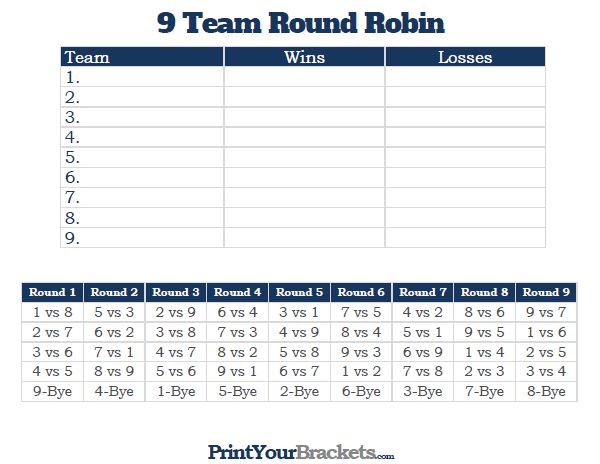
When you have nine teams, you’re dealing with an odd number, which naturally presents a slight scheduling challenge. Unlike even numbers where every team can play another team in each round, an odd number means one team will always be without an opponent. This isn’t a problem, just a feature you need to account for, usually by assigning a ‘bye’ week to one team per round. This ensures fairness and gives everyone a well-deserved break at some point during the season.
The most common and equitable method for scheduling in a league of this size is a round-robin format. In a single round-robin, every team plays every other team exactly once. This guarantees that no team has an unfair advantage or disadvantage in terms of opponents. For nine teams, this means each team will play eight games in total, as they will face the other eight teams once.
Calculating the total number of games for a single round-robin with N teams is simple: N multiplied by (N-1), then divided by 2. So, for 9 teams, it’s (9 * 8) / 2 = 36 games in total. Since there are nine teams, and one team sits out each round, there will be nine rounds in total to complete a single round-robin cycle. Each round will feature four games and one team on a bye.
Common Scheduling Formats for 9 Teams
When building your 9 team league schedule template, understanding the variations of the round-robin is helpful. This allows you to tailor the template to your league’s specific needs and time constraints.
Here are the primary types you might consider:
- Single Round Robin: As discussed, each team plays every other team once. This is great for shorter seasons or if you have limited venue availability. It’s simple, fair, and relatively quick to complete.
- Double Round Robin: In this format, each team plays every other team twice. This usually means a home game and an away game against each opponent, adding more depth and variety to the season. For a 9-team league, this would involve 72 games and take 18 rounds, with each team playing 16 games.
- Modified Round Robin: Sometimes, a full single or double round-robin isn’t feasible due to time or logistical constraints. A modified round-robin might involve playing only a subset of games, or perhaps playing a full round-robin followed by a playoff stage that doesn’t involve every team playing every other team again.
Remember, the goal is balance. Regardless of the format chosen, ensuring each team experiences an equal distribution of bye weeks and challenging opponents is paramount to maintaining a competitive and enjoyable environment for everyone involved.
Creating Your Own 9 Team League Schedule Template
While many online tools and pre-made templates can assist you, understanding the mechanics of how to build a 9 team league schedule template yourself gives you immense flexibility and control. It’s not as daunting as it sounds, and it ensures that your schedule perfectly aligns with your league’s unique requirements, whether it’s specific game days, venue availability, or player preferences.
The simplest manual method often involves numbering your teams from 1 to 9. Then, for each round, you can fix one team (say, Team 1) and rotate the other teams around it. For the ‘bye’ team, you can systematically rotate which team gets the bye each round. For instance, in round one, Team 9 might have the bye, in round two, Team 8, and so on. This ensures everyone gets their turn to rest without disrupting the flow of the games.
Alternatively, you can visualize the schedule using a spreadsheet. List your teams in a column and the rounds across the top. Then, fill in the opponents for each team in each round. This method allows you to easily track bye weeks and ensure no team is accidentally left out or scheduled for two games in one round. You can even color-code cells for home/away games or venue assignments, making your 9 team league schedule template incredibly robust.
Consider the practical aspects beyond just who plays whom. Are there specific days your venue is available? Do certain teams have player availability issues on particular evenings? A customizable template allows you to factor in these real-world constraints. For example, you might want to avoid scheduling rivalry matches too early or too late in the season, or ensure that teams don’t have back-to-back games if your league rules prohibit it.
- List all nine teams, perhaps assigning them a number.
- Determine the total number of rounds needed for your chosen format.
- Systematically assign a ‘bye’ team for each round to ensure fair distribution.
- Pair up the remaining teams for each round, ensuring no team plays itself or the same team twice in a single round-robin.
- Allocate home and away designations if applicable to your league.
- Integrate specific league rules, such as venue availability or rest days.
Once a draft schedule is created, it’s a good practice to share it with team captains or a small group of stakeholders for feedback. They might spot potential conflicts or suggest improvements that you overlooked. This collaborative approach not only refines the schedule but also fosters a sense of ownership and buy-in from the league participants, making your efforts to create a solid 9 team league schedule template even more successful.
A well-organized league truly enhances the experience for everyone involved, from players to administrators. By taking the time to create a fair and logical schedule, you lay the groundwork for a smooth and enjoyable season. Dealing with nine teams doesn’t have to be a scheduling nightmare; with a structured approach, it can be just as manageable as any other league size.
Whether you opt for a readily available 9 team league schedule template or decide to craft your own from scratch, the principles remain the same: fairness, clarity, and practicality. Armed with this understanding, you’re well-equipped to design a season that runs like clockwork, allowing everyone to simply focus on the thrill of the game. Here’s to a fantastic and well-scheduled season ahead!