Every business owner knows that assets dont last forever. From the office furniture that sees daily use to the sophisticated machinery powering production, these valuable items lose their worth over time. This gradual decline in value, known as depreciation, is a crucial concept in accounting and financial reporting. Properly tracking depreciation helps businesses accurately reflect their financial health, optimize tax liabilities, and make informed decisions about asset replacement.

Among the various methods for calculating depreciation, the straight line method stands out for its simplicity and ease of use. It spreads the cost of an asset evenly over its useful life, making it a favorite for many small and large businesses alike. To streamline this process and ensure accuracy, having a reliable straight line depreciation schedule template is incredibly beneficial, providing a clear roadmap for tracking an asset’s declining value year after year.
Understanding Straight Line Depreciation
The straight line depreciation method is arguably the most straightforward way to account for an asset’s wear and tear over time. It assumes that an asset loses an equal amount of value each year throughout its useful life. This predictable approach helps businesses maintain consistent financial records and simplifies long term financial planning, avoiding the complexities that might arise from accelerated depreciation methods.
To calculate straight line depreciation, you only need three key pieces of information. First, the asset’s initial cost, which includes its purchase price plus any expenses incurred to get it ready for use, like shipping or installation. Second, the salvage value, which is the estimated worth of the asset at the end of its useful life. And finally, the useful life itself, which is the period over which the asset is expected to provide economic benefits to the business.
The formula is elegantly simple: subtract the salvage value from the initial cost, then divide that number by the useful life of the asset. For example, if a machine costs 10,000, has an estimated salvage value of 1,000, and a useful life of 5 years, the annual depreciation would be (10,000 – 1,000) / 5 = 1,800. This fixed annual expense makes it easy to forecast future financial statements and track an asset’s book value year after year.
Businesses often choose this method because of its clarity and consistent impact on financial statements. It prevents sudden swings in reported profits that might occur with other methods, offering a steady and predictable expense that can be easily understood by stakeholders. This consistency is particularly valuable for small businesses or those new to managing complex accounting procedures, providing a solid foundation for financial management without unnecessary complications.
Key Components of the Calculation
- Initial Cost: This is the total amount paid for the asset, including purchase price, taxes, shipping, and setup costs. It represents the asset’s original value on your books.
- Salvage Value: The estimated residual value of an asset at the end of its useful life. This is what you expect to sell it for, or its scrap value. Some assets might have a zero salvage value.
- Useful Life: The period over which an asset is expected to be available for use by an entity, or the number of production units expected to be obtained from the asset. This can be expressed in years, hours, or units produced.
Having a clear understanding of these three elements is fundamental to accurately applying the straight line depreciation method and ensuring your financial records are up to date and compliant.
Building Your Own Straight Line Depreciation Schedule Template
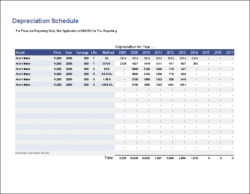
Creating an effective straight line depreciation schedule template means organizing all the necessary information in a clear, digestible format. Whether you prefer a simple spreadsheet in Excel or Google Sheets, or integrate it into more sophisticated accounting software, the underlying structure remains consistent. The goal is to have a dynamic tool that automatically calculates and tracks depreciation over an asset’s entire useful life, minimizing manual errors and saving valuable time.
A well-designed template typically includes several key columns that provide a comprehensive view of an asset’s depreciation journey. You will likely want to track the year of depreciation, the beginning book value of the asset for that year, the calculated annual depreciation expense, the accumulated depreciation up to that point, and the ending book value. These columns work together to show how the asset’s value decreases on your balance sheet and how much expense is recognized on your income statement each period.
For example, your template might start with the asset’s initial cost in year zero. In year one, it would calculate the annual depreciation expense, subtract that from the initial cost to get the ending book value, and record that same expense as accumulated depreciation. For subsequent years, the previous year’s ending book value becomes the current year’s beginning book value, and the annual depreciation expense continues to be added to the accumulated depreciation, consistently reducing the book value until it reaches the salvage value.
What a Good Template Includes
- Asset Identification: Clear details about the asset, such as its name, purchase date, and any unique identification numbers.
- Depreciation Inputs: Dedicated cells for initial cost, salvage value, and useful life, making it easy to update or replicate for new assets.
- Annual Calculations: Rows for each year of the asset’s useful life, showing the yearly depreciation expense.
- Running Totals: Columns for accumulated depreciation and the asset’s current book value, providing a snapshot of its remaining worth.
- Summary Information: A section that totals the entire depreciation over the asset’s life, ensuring everything balances out.
This structured approach helps ensure all figures are correct and provides a ready reference for auditors or financial analysis. A robust straight line depreciation schedule template is not just a calculation tool; it’s a vital record keeping system that supports accurate financial reporting and compliance.
Managing your business assets effectively is paramount for sustained financial health. By embracing the simplicity and clarity of the straight line depreciation method and utilizing a well-structured schedule, you can keep a precise tab on your asset values and make smarter financial decisions. This systematic approach ensures that your accounting records always reflect an accurate picture of your assets true worth over their lifespan.
In essence, whether you are a startup acquiring your first piece of equipment or an established enterprise managing a diverse portfolio of assets, a dependable straight line depreciation schedule template is an invaluable asset itself. It simplifies complex accounting requirements, provides clear insights into your financial standing, and ensures you are always prepared for tax season, making your financial management both efficient and transparent.