Navigating the complexities of share ownership changes within a company requires meticulous attention to detail and proper documentation. Whether you’re transferring shares as a gift, a sale, or part of a broader corporate restructuring, a well-drafted transfer of shares letter template is an indispensable tool. This crucial document ensures clarity, legality, and a smooth transition of equity ownership.
Failing to properly document a share transfer can lead to significant legal complications, disputes among shareholders, and administrative headaches down the line. A standardized template provides a clear framework, helping all parties understand their obligations and rights. It acts as a formal record, safeguarding the interests of both the transferor and the transferee.
This article will guide you through the intricate process of transferring shares, explaining why a robust letter template is essential. We will delve into the critical components, legal considerations, and practical steps needed to ensure your share transfer is executed flawlessly and in full compliance with relevant regulations.
Understanding The Share Transfer Process
The act of transferring shares signifies a change in the ownership of a company’s equity. This process is more than just a simple exchange; it involves legal recognition, updating company records, and often, adherence to specific company articles or shareholder agreements. A clear understanding of this process is fundamental before drafting any documentation.
Effective share transfer management is crucial for maintaining accurate company records and ensuring corporate governance. Without proper documentation, the legal standing of new shareholders can be challenged, impacting their rights, such as voting or dividend entitlements. This underscores the necessity of having a reliable system in place.
Key Elements Of A Valid Share Transfer
For any share transfer to be legally binding and effective, several key elements must be present and correctly executed. These components ensure that the transaction is legitimate and recognized by law and the company itself. Omitting any of these can invalidate the entire transfer.
- Identification of Parties: Clearly state the full legal names and addresses of both the transferor (the current shareholder) and the transferee (the new shareholder).
- Company Details: Include the full legal name and registration number of the company whose shares are being transferred.
- Share Particulars: Specify the exact number and class of shares being transferred, along with their distinctive numbers if applicable.
- Consideration: State the amount paid or the value exchanged for the shares, or explicitly mention if it’s a gift or inheritance.
- Transfer Date: The exact date the share transfer takes effect is vital for record-keeping and calculating ownership periods.
- Signatures: Both the transferor and transferee must sign the document, and it often requires witnessing to confirm authenticity.
- Share Certificate Details: Reference the original share certificate number and confirm its surrender or cancellation, and the issuance of a new one.
When Is A Share Transfer Letter Needed?
A formal communication, often in the form of a share transfer letter, is essential in various scenarios involving equity ownership changes. This letter typically accompanies a formal share transfer form or deed, providing an additional layer of clarity and instruction. It helps formalize the intent behind the transfer.
Consider a share transfer letter necessary in situations like the sale of shares between individuals, gifting shares to family members, or transferring shares as part of an inheritance or estate planning. It also becomes crucial when shares are moved between trusts or corporate entities, ensuring full transparency.
The letter can also serve as an instruction to the company secretary or board of directors to register the transfer in the company’s register of members. This administrative step is critical for the new shareholder to be officially recognized and to exercise their rights.
Legal And Regulatory Considerations
The transfer of company shares is subject to a robust framework of legal and regulatory requirements that must be carefully observed. These regulations vary by jurisdiction and company type, influencing the documentation and approval processes. Adhering to these rules prevents legal challenges.
Company articles of association often contain clauses restricting share transfers, such as pre-emption rights for existing shareholders. It is essential to review these articles and any relevant shareholder agreements before initiating a transfer. Failure to comply could render the transfer void.
Stamp duty may also be payable on the transfer of shares, depending on the jurisdiction and the value of the shares. Companies must ensure they fulfill their obligations regarding stamp duty payment and submission of relevant forms to tax authorities. Legal advice is frequently recommended to navigate these complexities.
Crafting Your Transfer Of Shares Letter Template
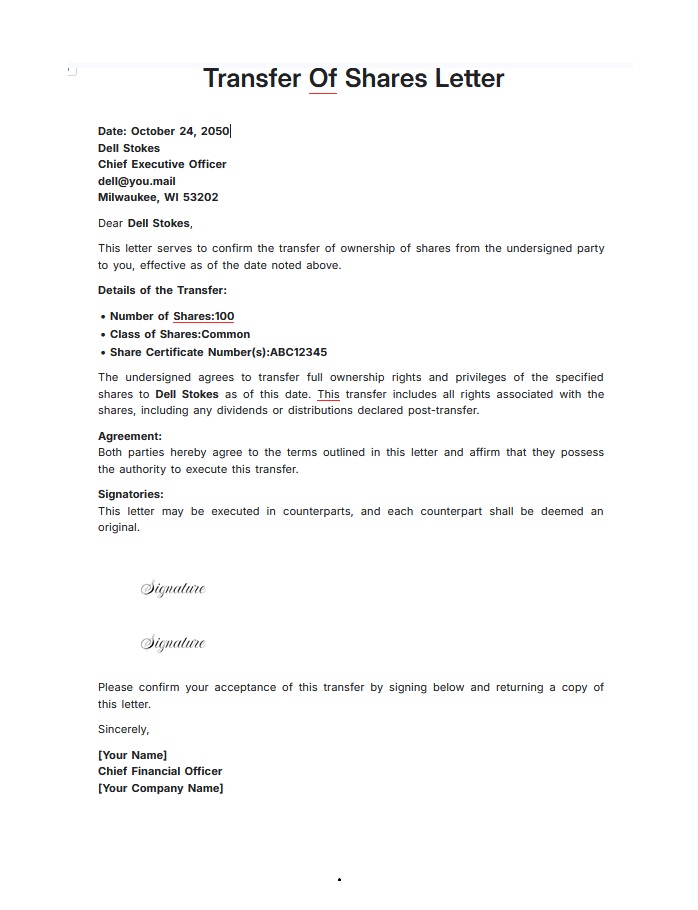
Developing an effective transfer of shares letter template simplifies the process and ensures consistency across all your share transfer activities. A well-structured template provides a reliable framework, reducing the risk of errors and omissions that could delay or invalidate a transfer. It serves as a professional and legally sound communication.
The template should be versatile enough to adapt to different transfer scenarios while maintaining core essential information. It acts as a bridge between the formal legal documents and the administrative process, ensuring all stakeholders are clear on the details of the equity movement.
Essential Components Of The Letter
Every well-crafted letter template for share transfers must include specific pieces of information to be complete and legally sound. These elements ensure that the intent, details, and execution of the transfer are unambiguous. Neglecting any component can lead to confusion or disputes.
- Date: The date the letter is written.
- Recipient’s Name and Address: Typically the Company Secretary or Board of Directors of the company whose shares are being transferred.
- Sender’s Name and Address: The transferor (current shareholder) or their legal representative.
- Subject Line: A clear and concise subject, e.g., “Request for Registration of Share Transfer.”
- Formal Salutation: Addressing the recipient professionally.
- Body Paragraph 1: State the purpose of the letter – to formally notify of a share transfer.
- Body Paragraph 2: Provide details of the shares being transferred: company name, number of shares, class, and distinctive numbers (if applicable).
- Body Paragraph 3: Identify the transferor and transferee by their full legal names and addresses.
- Body Paragraph 4: Confirm that the accompanying Share Transfer Form or Deed has been duly executed and enclosed.
- Body Paragraph 5: Request the company to register the transfer in its Register of Members and issue a new share certificate to the transferee.
- Closing: Professional closing, e.g., “Sincerely” or “Yours faithfully.”
- Signature: Signature of the transferor.
- Printed Name: Printed name of the transferor.
- Enclosures: List all attached documents, such as the original share certificate, the executed share transfer form/deed, and any stamp duty forms.
Step-by-Step Guide To Writing The Letter
Writing a transfer of shares letter can be straightforward if you follow a structured approach. This guide helps ensure that all necessary information is included in a clear, concise, and legally compliant manner. Accuracy and completeness are paramount in this process.
- Gather All Information: Before you begin, collect all details: full names and addresses of transferor and transferee, company name and registration number, number and class of shares, original share certificate details, and the consideration amount.
- Choose a Template: Select a reliable transfer of shares letter template or start with a blank document, ensuring it has all the essential sections outlined above.
- Fill in Details Accurately: Carefully input all gathered information into the respective fields of your letter. Double-check names, addresses, and share particulars for any typographical errors.
- Reference Accompanying Documents: Explicitly mention all documents that will be enclosed with the letter, such as the share transfer form/deed and the original share certificate. This serves as a checklist.
- Review and Proofread: Read through the entire letter to catch any grammatical errors, spelling mistakes, or factual inaccuracies. Ensure the tone is professional and clear.
- Sign and Date: The transferor must sign the letter with their full legal signature. Ensure the date on the letter matches the date it is being sent or formally submitted.
- Prepare Enclosures: Attach all referenced documents securely to the letter. Make copies of all submitted documents for your records.
Common Mistakes To Avoid
When preparing a share transfer letter, several common errors can lead to delays, legal complications, or even the rejection of the transfer. Being aware of these pitfalls can help you ensure a smooth and effective process. Diligence in preparation is key.
One frequent mistake is providing incomplete or inaccurate information, such as misspelled names, incorrect share numbers, or outdated addresses. Such discrepancies can cause the company registrar to reject the transfer, requiring resubmission and wasting valuable time. Always verify all data.
Another common oversight is failing to include all required supporting documents, like the original share certificate or the duly executed share transfer form. The letter serves as an instruction, but the underlying legal documents are what effectuate the change. Always list and attach all enclosures.
Ignoring company specific rules, such as pre-emption rights or board approval requirements, can also derail a transfer. It is crucial to consult the company’s articles of association and any shareholder agreements before drafting the letter. Non-compliance can lead to legal challenges to the transfer’s validity.
The proper transfer of shares is a critical administrative and legal function that demands precision and adherence to established protocols. Utilizing a robust transfer of shares letter template streamlines this process, ensuring all necessary information is included and communicated effectively. This not only safeguards the interests of all parties involved but also maintains the integrity of the company’s ownership records.
By following a structured approach, understanding the legal nuances, and paying meticulous attention to detail, you can navigate share transfers with confidence. Remember that accurate documentation is the bedrock of transparent and legally sound equity management. For complex situations, always consider seeking professional legal counsel to ensure full compliance and peace of mind.