As a healthcare professional, especially in nursing, you know that a comprehensive patient assessment is the bedrock of excellent care. It’s not just about ticking boxes; it’s about truly understanding your patient’s current state, identifying potential issues early, and forming an individualized care plan. This vital process, often referred to as a head-to-toe assessment, requires a systematic approach to ensure nothing is missed and every area of the patient’s well-being is considered.

However, remembering every single step, every system to check, and every question to ask can be overwhelming, especially during busy shifts or when you’re just starting out. That’s where having a clear, concise, and easy-to-follow nursing head to toe assessment template becomes an absolute game-changer. It acts as your guide, your checklist, and your memory aid, ensuring you conduct thorough assessments consistently, every single time.
The Indispensable Role of a Structured Nursing Head to Toe Assessment Template
Imagine walking into a patient’s room without a clear plan for your assessment. You might start with vitals, then move to their IV, perhaps check their breathing, and then get distracted by a call light. Without a structured approach, it’s easy to miss crucial details, leading to incomplete data and potentially delayed interventions. This is precisely why a well-designed template isn’t just a convenience; it’s a critical tool for patient safety and quality care. It provides a logical flow, guiding you through each body system in an organized manner, preventing omissions and ensuring consistency across all your patient encounters.
For new nurses, a template can be a lifesaver, reducing anxiety and building confidence by providing a clear roadmap for what needs to be done. It reinforces the knowledge learned in school and helps solidify the routine of a thorough assessment. Even for seasoned professionals, it serves as an invaluable quick reference, particularly during high-stress situations or when dealing with complex cases. It helps maintain the high standards of care that are expected, no matter how many years of experience you have under your belt.
Beyond individual performance, a standardized nursing head to toe assessment template also fosters better communication within the healthcare team. When all nurses follow a similar structure for their assessments, the documented information becomes more consistent and easier for other team members – like doctors, charge nurses, or other shifts – to interpret quickly. This shared understanding facilitates more effective handovers and ensures that everyone is on the same page regarding the patient’s condition and ongoing needs. It streamlines the information exchange, making the transition between care providers seamless and safe.
Ultimately, the goal of any assessment is to gather accurate data that informs clinical decisions. A template ensures that this data is collected systematically, leading to a more complete picture of the patient’s health status. This proactive approach allows for the early detection of changes in condition, prompt intervention, and ultimately, better patient outcomes. It transforms a potentially haphazard process into a precise, efficient, and highly effective component of daily patient care.
Key Benefits in Detail
- Ensures consistency across all patient assessments.
- Reduces the likelihood of missing critical information or observations.
- Improves efficiency by streamlining the assessment process.
- Facilitates better communication and handovers among the healthcare team.
- Enhances patient safety through early detection of changes in condition.
- Supports comprehensive and accurate documentation.
Crafting Your Perfect Nursing Head to Toe Assessment Template
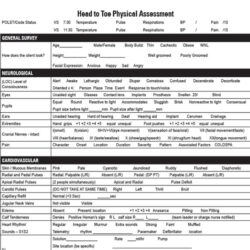
When building or choosing a nursing head to toe assessment template, think about what elements are absolutely essential for a comprehensive evaluation. A good template doesn’t just list body parts; it prompts you to assess the function, appearance, and any relevant symptoms associated with each system. It begins with a general survey, observing the patient’s overall appearance, level of consciousness, mood, and any immediate distress, setting the stage for the more detailed examination to follow. This initial impression can offer significant clues about their underlying condition.
Next, you’ll want to include a section for vital signs, as these objective measurements provide immediate indicators of physiological status. Following this, a logical progression through the major body systems is crucial. Consider starting with the neurological system, assessing orientation, pupillary response, and motor strength. Then move to the cardiovascular and respiratory systems, focusing on heart sounds, peripheral pulses, capillary refill, lung sounds, and oxygen saturation. These core systems are fundamental to patient stability and need meticulous evaluation.
The gastrointestinal and genitourinary systems are also key components, where you’ll assess bowel sounds, abdominal tenderness, diet tolerance, and urine output, among other parameters. Don’t forget the integumentary system, which involves checking skin integrity, color, temperature, turgor, and the presence of any wounds or lesions. Finally, assessing the musculoskeletal system for range of motion, strength, and any pain helps complete the picture of the patient’s physical state. Each section should guide you to observe, palpate, auscultate, and percuss as appropriate.
Beyond physical findings, an effective template also includes sections for subjective data, such as pain assessment using a standardized scale, and psychosocial considerations. This holistic approach ensures you’re not just treating a set of symptoms, but caring for a whole person. Remember to also include areas for documenting IV sites, drains, and any other pertinent medical devices. A comprehensive template should be adaptable to different patient populations and settings, whether in an emergency room, a medical-surgical floor, or a long-term care facility, allowing for minor adjustments as needed.
Essential Categories to Include
- General Survey (Level of Consciousness, Affect, Speech)
- Vital Signs (BP, HR, RR, Temp, O2 Sat, Pain)
- Neurological Assessment (Orientation, Pupils, Grip Strength, Sensation)
- Cardiovascular Assessment (Heart Sounds, Peripheral Pulses, Capillary Refill, Edema)
- Respiratory Assessment (Breath Sounds, Respiratory Effort, Cough)
- Gastrointestinal Assessment (Bowel Sounds, Abdomen Palpation, Last BM, Diet)
- Genitourinary Assessment (Urine Output, Voiding Pattern)
- Integumentary Assessment (Skin Integrity, Color, Temperature, Turgor, Wounds)
- Musculoskeletal Assessment (Range of Motion, Muscle Strength, Gait)
- Pain Assessment (Location, Intensity, Character)
- IV Site/Lines/Drains Assessment (Location, Condition, Patency)
- Psychosocial Assessment (Mood, Support System)
Embracing a well-designed template for your head-to-toe assessments can significantly elevate the quality of care you provide. It serves as an invaluable professional asset, not only in ensuring thoroughness and accuracy in your daily practice but also in fostering your growth as a diligent and effective caregiver. By systematically gathering and documenting comprehensive patient data, you contribute directly to improved patient safety and better health outcomes.
The commitment to using such a structured approach reflects a dedication to excellence in nursing. It’s a foundational practice that underpins all other aspects of patient care, providing the crucial insights needed to make informed clinical decisions. As you integrate this robust tool into your routine, you’ll find that it empowers you to be more efficient, more confident, and ultimately, a more impactful presence in your patients’ healing journeys.