Embarking on the journey of making a short film is an exciting creative endeavor, but it can also quickly become overwhelming without a clear roadmap. From securing locations and talent to managing crew and equipment, there are countless moving parts that need to align perfectly for your vision to come to life. Many aspiring filmmakers often underestimate the sheer logistical challenge involved, leading to frustrating delays, budget overruns, and sometimes, even incomplete projects.

This is where meticulous planning becomes your best friend. Just as a director needs a script to guide the story, a production needs a schedule to guide its execution. It’s the backbone of any successful film set, ensuring everyone knows what’s happening, when, and where. Without one, you’re essentially trying to navigate a complex maze blindfolded. But don’t worry, creating such a plan doesn’t have to be a daunting task; in fact, a well-designed short film shooting schedule template can simplify this entire process significantly.
Why You Need a Shooting Schedule for Your Short Film
Imagine a bustling film set, lights being adjusted, actors getting into character, cameras being prepped, and everyone buzzing with activity. Now, picture all of that happening without a clear plan for what scene comes next, who needs to be where, or what equipment is required. Chaos would ensue, wouldn’t it? A shooting schedule is precisely what prevents this by providing a minute-by-minute, hour-by-hour breakdown of your production days. It’s more than just a timeline; it’s a strategic document that orchestrates every single element of your shoot.
Having a robust schedule in place empowers your entire team, from the director to the production assistant. It minimizes guesswork, reduces the potential for costly mistakes, and ensures that precious time and resources are utilized to their fullest potential. Instead of constantly reacting to unforeseen issues, you’ll be proactively managing your production, allowing you to focus more on the creative aspects rather than logistical firefighting. This clarity is invaluable for maintaining morale and keeping everyone aligned towards the common goal.
Key Benefits of a Solid Schedule
- **Time Optimization:** Every minute on set costs money. A schedule ensures you shoot efficiently, minimizing downtime and maximizing productivity.
- **Budget Control:** By planning thoroughly, you can avoid overtime, unexpected equipment rentals, and last-minute location changes that drain your budget.
- **Resource Allocation:** It allows you to track and manage your cast, crew, equipment, and locations, ensuring the right people and tools are available exactly when needed.
- **Improved Communication:** A shared schedule ensures everyone on your team, from the actors to the sound mixer, is on the same page regarding daily objectives.
- **Problem Prevention:** By anticipating potential bottlenecks or challenges in advance, you can develop contingency plans before they become major issues.
Ultimately, a detailed schedule, particularly when organized using a comprehensive short film shooting schedule template, serves as a central point of reference. It’s a living document that guides your entire production process, ensuring that every piece of your creative puzzle fits together smoothly and efficiently, leading to a much higher quality final product and a far less stressful journey to get there.
Components of an Effective Short Film Shooting Schedule
Building an effective shooting schedule is akin to assembling a complex machine; each part must be precisely designed and placed for the whole system to function. It’s not enough to simply list scenes; a truly useful schedule provides granular detail for every single shot and sequence. This level of detail ensures that when you arrive on set, there are no ambiguities, and everyone knows their role and responsibilities for that particular segment of the day.
A well-crafted schedule pulls information from your script breakdown, which itself identifies all the elements needed for each scene. This includes everything from the location and time of day (day/night, interior/exterior) to the specific cast members required, props, special effects, and even the type of camera moves planned. Consolidating all this information into a clear, digestible format is crucial for smooth execution.
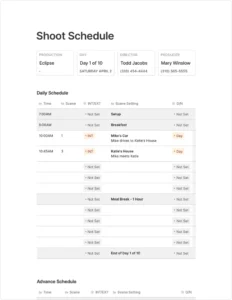
Here’s what you should typically include in each entry of your schedule:
- **Scene Number and Title:** For easy cross-referencing with your script and shot list.
- **Script Pages:** The exact page numbers or fractions of pages covered by the scene, helping estimate shooting time.
- **Location:** The precise address or description of where the scene will be shot.
- **Cast Members:** A list of all actors required for that specific scene, including their character names.
- **Crew Members:** Notation of any specialized crew (e.g., specific grip, gaffer, or makeup artist) needed.
- **Equipment:** Any particular cameras, lenses, lighting, sound gear, or grip equipment essential for the scene.
- **Time Allotment:** Estimated time for setup, actual shooting, and wrap-up for the scene.
- **Special Requirements:** Any unique props, costumes, stunts, visual effects, or practical effects.
- **Day/Night/Interior/Exterior (D/N I/E):** Critical for planning lighting, power, and logistical considerations.
By systematically compiling these details, your short film shooting schedule template transforms into a powerful organizational tool. It allows you to group scenes logically, perhaps shooting all scenes in one location on consecutive days, or scheduling all scenes with a particular actor together to optimize their availability. This strategic approach to scheduling not only saves time and money but also reduces the overall stress on your cast and crew, making the production process more enjoyable and efficient for everyone involved.
Developing a robust shooting schedule is one of the most critical steps in pre-production. It’s the blueprint that guides your entire crew, helping to prevent miscommunication, costly delays, and wasted effort. Taking the time to craft a detailed and realistic plan upfront will pay dividends throughout your production, enabling you to focus on the artistic execution rather than logistical headaches.
Ultimately, your success in bringing your short film to life hinges significantly on how well you prepare. A meticulously planned schedule ensures that every day on set is productive, every dollar is spent wisely, and every creative decision is supported by solid logistics. This careful preparation ensures a smoother, more efficient, and ultimately more rewarding filmmaking experience.