Organizing a sporting event or a friendly competition can be a truly rewarding experience, but let’s be honest, the planning phase often brings its own set of challenges. One of the trickiest parts, especially when you have a specific number of participants, is creating a fair and balanced schedule that ensures every team gets their chance to shine. If you’re managing a tournament with eight teams, you’ve likely realized that a simple “who plays who” list just won’t cut it.

That’s where the magic of a round robin format comes into play. It’s a fantastic system because it guarantees that every single team will play against every other team at least once, promoting fairness and maximizing the competitive spirit. For an eight-team setup, this means a consistent structure is key to avoiding confusion and ensuring smooth gameplay throughout your event.
Understanding the Basics of an 8-Team Round Robin
A round robin tournament is a competition in which each contestant (in this case, each team) meets every other contestant in turn. It’s widely considered the fairest type of tournament format because it minimizes the impact of a single bad day or a lucky draw, as all teams face the same opposition. For an 8-team setup, this means every team plays seven other teams, leading to a total of 28 matches (calculated as N*(N-1)/2, where N is the number of teams).
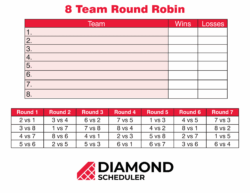
The structure for an 8-team round robin is quite straightforward, requiring a total of seven rounds to complete. In each round, four matches will take place simultaneously, ensuring that all eight teams are engaged. This systematic approach not only prevents any team from feeling left out but also provides ample opportunities for every participant to test their skills against a diverse range of opponents. It’s this comprehensive nature that makes the round robin format so popular for leagues, group stages, and championship series where fairness is paramount.
While the concept is simple, manually mapping out who plays who in each of the seven rounds can quickly become a tedious task, especially if you want to optimize for factors like venue availability or specific team preferences. Without a clear methodology, you might find yourself accidentally scheduling the same teams to play twice or missing a matchup entirely. This is why having a structured approach, or even better, a ready-made framework, can be incredibly helpful.
Imagine trying to juggle eight different entities and ensuring each one crosses paths with the other seven precisely once, all while keeping the schedule balanced across multiple rounds. It requires careful rotation and attention to detail. Thankfully, there are established methods that simplify this process considerably, turning what might seem like a complex puzzle into an organized plan.
Simple Steps to Create Your Own Schedule
- List all your teams: Assign a number or name to each team (e.g., Team 1, Team 2, …, Team 8).
- Fix one team: For the standard “circle method,” you’ll keep one team stationary (let’s say Team 1).
- Arrange the remaining teams: Place the other seven teams in a circle around Team 1.
- Round 1 matchups: Team 1 plays the team directly opposite it. The remaining teams pair up with the team immediately to their right or left on the circle.
- Rotate for subsequent rounds: To generate the next round, keep Team 1 fixed and rotate the other seven teams one position clockwise (or counter-clockwise) around the circle. Repeat this seven times to complete all rounds.
Leveraging an 8 Team Round Robin Schedule Template for Efficiency
While creating a schedule from scratch using the methods described above is certainly possible, the sheer convenience and time-saving benefits of using an 8 team round robin schedule template cannot be overstated. These templates are pre-designed with the correct pairings and rotations, taking away the headache of manual calculation and the risk of human error. Instead of spending valuable time figuring out the logistics, you can instantly populate the template with your team names and focus on the more exciting aspects of your event, like promoting it or preparing the playing fields.
A good 8 team round robin schedule template will be clear, easy to read, and often customizable. Look for templates that are available in formats like spreadsheets (Excel, Google Sheets) or even printable PDFs, allowing you to choose the medium that best suits your organizational style. The beauty of a digital template is the flexibility it offers to quickly adjust names, add specific dates, times, and locations for each match, or even integrate scoring columns directly into the document.
The customization options truly make a template shine. You might want to add columns for scores, win/loss records, tie-breaking criteria, or even specific referee assignments for each game. Some advanced templates might even include conditional formatting to highlight current leaders or upcoming matches, providing a dynamic overview of your tournament’s progress. This level of detail, effortlessly integrated, elevates your organizational game and presents a professional image to all participants.
Finding an 8 team round robin schedule template is typically straightforward. Many sports organizations, tournament planning websites, and even office software suites offer free downloadable templates. A quick online search will yield numerous options, giving you the power to pick one that aesthetically and functionally aligns with your needs. Whether you prefer a minimalist design or something with more visual flair, there’s likely a template out there ready to be put to use for your next event.
- Downloadable spreadsheet files (Excel, Google Sheets, OpenOffice Calc) for easy digital editing.
- Printable PDF versions for quick physical distribution.
- Online schedule generators that can produce a unique schedule based on your inputs.
- Templates that include space for match results, points, and team standings.
- Visually appealing designs that are easy for participants to understand at a glance.
Organizing a successful tournament hinges on meticulous planning, and the foundation of any multi-team competition is its schedule. By adopting a well-structured round robin for your eight teams, you are already setting a high standard for fairness and comprehensive play. This ensures every participant feels valued and gets an equal opportunity to compete against all others.
Ultimately, leveraging an 8 team round robin schedule template frees you from the mundane task of manual schedule creation. It empowers you to dedicate your energy to the live event itself, cultivating a fantastic experience for all the teams involved and fostering a truly memorable competition without the usual pre-tournament planning stress.