Receiving a notice from the tax authorities, particularly one that includes a penalty, can be an incredibly stressful experience. Many taxpayers automatically assume they must pay the stated amount, but this isn’t always the case. Understanding your options, including the possibility of appealing the penalty, can save you significant money and stress. A well-crafted tax penalty appeal letter template is your essential tool in this process.
Whether you’re facing penalties for late filing, late payment, or an accuracy-related issue, the IRS and state tax agencies often offer avenues for relief. These agencies recognize that honest mistakes, unforeseen circumstances, or reasonable causes can sometimes prevent taxpayers from meeting their obligations. Knowing how to present your case effectively is crucial for a successful appeal.
This comprehensive guide will walk you through the types of penalties you might encounter, the grounds for appealing them, and, most importantly, provide you with the knowledge to create a powerful appeal letter. We’ll explore the key components and strategies needed to advocate for penalty abatement, helping you navigate the complexities of the tax system with greater confidence.
Understanding Common Tax Penalties and Abatement Grounds
Tax penalties are imposed for various reasons, primarily to encourage compliance with tax laws. However, the IRS acknowledges that circumstances can sometimes arise that prevent taxpayers from meeting their obligations. Identifying the specific penalty you received is the first step toward building an effective appeal.
The most common types of tax penalties include failure to file, failure to pay, and accuracy-related penalties. Each carries its own set of rules and potential relief options. For instance, the failure to file penalty can be quite substantial, often 5% of the unpaid taxes for each month or part of a month that a tax return is late, up to 25% of your unpaid tax.
Common Reasons for IRS Penalties
Tax authorities impose penalties when taxpayers don’t fulfill their responsibilities. Understanding these triggers is crucial before crafting your appeal. These penalties are designed to ensure the tax system operates smoothly and fairly.
- Failure to File: This penalty is assessed if you don’t file your tax return by the due date, including extensions. It’s often one of the most significant penalties you might face.
- Failure to Pay: If you don’t pay the taxes reported on your return by the due date, you could incur this penalty. It’s usually a percentage of the unpaid taxes.
- Accuracy-Related Penalties: These are levied when there’s an understatement of tax due to negligence, disregard of rules, or substantial understatement of income tax. These can be particularly complex to dispute.
- Failure to Deposit: Businesses can face this penalty if they don’t make employment tax deposits correctly or on time. Specific rules apply here for timely and accurate deposits.
Qualifying for Penalty Abatement
Many taxpayers are eligible for penalty relief under specific circumstances, often referred to as “reasonable cause.” This is where a well-structured tax penalty appeal letter template becomes invaluable. The IRS considers various factors when evaluating reasonable cause.
To qualify, taxpayers must show that they exercised ordinary business care and prudence in determining their tax obligations but were unable to comply. This could involve showing that the event causing non-compliance was beyond your control. The burden of proof typically lies with the taxpayer.
Here are common grounds for reasonable cause:
- Death or Serious Illness: The death or serious illness of the taxpayer or an immediate family member.
- Natural Disaster or Casualty: Destruction of records or inability to meet deadlines due to events like hurricanes, fires, or floods.
- Undue Hardship: Demonstrating that paying the penalty would cause significant financial distress.
- Incorrect Advice: Relying on erroneous written advice from the IRS.
- Inability to Obtain Records: Due to circumstances beyond your control, you couldn’t access necessary documents.
- First-Time Penalty Abatement (FTA): This administrative waiver is often granted if you have a clean compliance history for the prior three years, filed all required returns, and paid any tax due (or arranged to pay).
Key Documentation for Your Appeal
Supporting your appeal with robust evidence is critical to its success. Without proper documentation, your claims of reasonable cause may be difficult to verify. Gather all relevant papers before you start writing.
- IRS Notice: The specific penalty notice you received (e.g., CP14, CP22A, CP161).
- Medical Records: If illness was the cause, provide doctor’s notes, hospital bills, or death certificates.
- Police Reports/Insurance Claims: For natural disasters or theft that affected your ability to comply.
- Financial Records: Bank statements, income/expense reports if claiming financial hardship.
- Correspondence: Any prior letters or communications with the IRS regarding the issue.
- Tax Returns: Copies of the affected tax return and proof of filing.
- Proof of Payment: Canceled checks or bank statements showing tax payments made.
Crafting an Effective Tax Penalty Appeal Letter
A compelling appeal letter is your primary tool for communicating with the tax authority. It needs to be clear, concise, and persuasive, outlining your reasons for relief and providing supporting evidence. Think of it as your official statement.
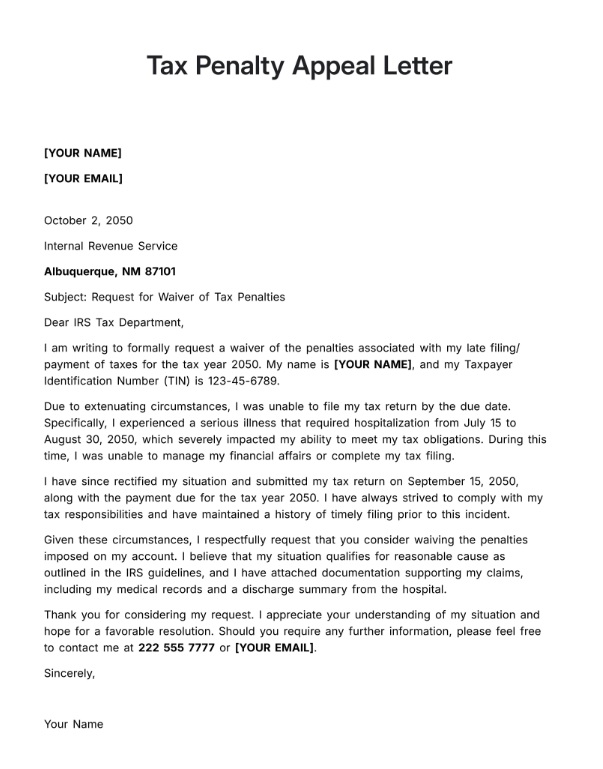
Utilizing a reliable tax penalty appeal letter template can help ensure you include all necessary information and structure your argument logically. Remember, the goal is to present a narrative that demonstrates you acted responsibly despite circumstances that led to the penalty.
Essential Components of Your Appeal Letter
Every effective appeal letter shares a common structure designed to clearly convey your request and the reasons behind it. Skipping any of these components could weaken your appeal. Be methodical in your approach to ensure thoroughness.
The following elements are crucial for a complete and persuasive appeal:
| Component | Description | Example Detail |
|---|---|---|
| Your Contact Information | Full name, current address, phone number, SSN/EIN. | John Doe, 123 Main St, Anytown, CA 90210, SSN: XXX-XX-XXXX |
| IRS/Agency Address | Specific address from your penalty notice. | Internal Revenue Service, PO Box YYY, City, State ZIP |
| Date | Date the letter is written. | January 1, 2024 |
| Subject Line | Clear statement of purpose, including penalty notice number. | Appeal for Penalty Abatement – Notice CP14 – Tax Year 2022 |
| Salutation | Formal greeting. | Dear IRS Penalty Abatement Unit, |
| Statement of Request | Clearly state you are requesting penalty abatement and for which penalty. | “I am writing to request abatement of the Failure to Pay Penalty assessed on Notice CP14 for the tax year 2022.” |
| Explanation of Reasonable Cause | Detailed, chronological explanation of why you couldn’t meet obligations. | “During the filing period, my spouse experienced a severe medical emergency (attached medical records). This unforeseen event…” |
| Supporting Documentation | List all attached documents. | “Please find enclosed copies of: 1) Notice CP14, 2) Medical records, 3) Bank statements…” |
| Call to Action/Conclusion | Reiterate your request and express willingness to provide more info. | “I respectfully request that the penalty be abated. I am available to provide any additional information needed.” |
| Closing | Formal closing. | Sincerely, |
| Signature | Your physical signature (for mailed letters). | (Your Signature) |
| Typed Name | Your typed name below your signature. | John Doe |
Tips for Strengthening Your Argument
Beyond the basic structure, certain strategies can significantly enhance the persuasiveness of your appeal. Presenting your case clearly and logically is paramount. The goal is to make it easy for the tax officer to understand and approve your request.
- Be Specific and Factual: Avoid emotional language. Stick to the facts, dates, and direct consequences of the events. Explain how the specific circumstances prevented you from complying.
- Maintain a Professional Tone: Your letter should be respectful and formal. Remember you are dealing with a government agency.
- Cite Relevant IRS Guidance (if applicable): If you are aware of specific IRS codes or publications that support your case, briefly reference them. This shows you’ve done your homework.
- Timeliness Matters: Submit your appeal as soon as possible after receiving the penalty notice. Delay can sometimes weaken your case or reduce the amount of relief available.
- Keep Copies: Always keep a copy of your appeal letter and all supporting documentation for your records. If mailing, consider using certified mail with a return receipt.
What Happens After You Submit Your Appeal
Once your tax penalty appeal letter template has been filled out and sent, the waiting game begins. The tax agency will review your submission, which can take several weeks or even months depending on their workload. It’s important to know what to expect during this period.
You typically won’t receive an immediate response. The IRS will review your case based on the information provided and their internal guidelines for penalty abatement. They may contact you for additional information or clarification during this process.
If your appeal is approved, you will receive a notice confirming the abatement of the penalty. If it’s denied, the notice will usually explain the reason for the denial and inform you of your appeal rights, which may include appealing to the IRS Independent Office of Appeals. Don’t be discouraged by an initial denial; sometimes, further review can lead to a different outcome.
Navigating the tax system can be daunting, especially when penalties are involved. However, understanding your rights and knowing how to effectively communicate your situation can make a significant difference. Utilizing a well-structured tax penalty appeal letter template, backed by strong documentation, empowers you to advocate for yourself and potentially secure penalty relief.
Remember, the goal is always to demonstrate that you acted with ordinary business care and prudence but were prevented from meeting your tax obligations due to circumstances beyond your control. By following the guidance outlined in this article, you can approach your penalty appeal with greater confidence and increase your chances of a successful outcome.