Navigating the complexities of modern business and organizational governance often feels like walking a tightrope. One wrong step can lead to significant ethical breaches, reputational damage, and even legal woes. At the heart of many such challenges lies the often-tricky area of conflicts of interest. These aren’t always glaringly obvious; sometimes they are subtle, emerging from seemingly innocent situations but possessing the potential to undermine trust and objectivity.

Understanding and effectively managing these potential conflicts is not just a best practice; it’s a fundamental requirement for any entity striving for transparency and integrity. This is precisely where a structured, systematic approach becomes invaluable. Instead of ad-hoc decisions or vague policies, a clear framework ensures consistency and fairness, helping everyone involved identify, declare, and mitigate such situations effectively.
Understanding Conflicts of Interest and Their Impact
A conflict of interest arises when an individual’s personal interests, whether financial, professional, or personal, could potentially interfere with their ability to act in the best interest of an organization or to make objective decisions. It’s not necessarily about ill intent; often, individuals might not even realize they are in a conflicted situation. The core issue is the potential for bias or the appearance of impropriety, which can erode confidence and lead to unfair outcomes.
The impact of unmanaged conflicts can be far-reaching and severe. For organizations, it can manifest as financial losses due to biased decision-making, damage to public perception, and a decline in employee morale. Legally, failing to address conflicts can result in hefty fines, lawsuits, and even criminal charges, depending on the nature of the organization and the jurisdiction. Trust, once broken, is incredibly difficult to rebuild, and a reputation tarnished by allegations of conflict can take years to recover.
Proactive identification and management are therefore crucial. It’s about creating an environment where potential conflicts are not hidden but openly declared and addressed through a transparent process. This protects not only the organization but also the individuals involved, by providing clear guidelines and support. Without such a framework, even the most well-intentioned individuals can find themselves in precarious positions.
This is precisely why having a robust system in place, ideally formalized through a tool like a conflict of interest assessment template, is non-negotiable for any entity committed to ethical operations. It moves the process from reactive firefighting to proactive prevention, building a culture of accountability and integrity from the ground up.
Common Scenarios Where Conflicts May Arise
* Financial Investments: An employee holding shares in a company bidding for a contract with their current employer.
* Personal Relationships: A manager hiring or promoting a close relative or friend.
* Gifts and Hospitality: Accepting significant gifts from a vendor who seeks to do business with your organization.
* Outside Employment or Activities: An employee working for a competitor or using company resources for a personal side business.
* Board Memberships: Serving on the board of two organizations that are direct competitors or that frequently interact commercially.
* Use of Confidential Information: Using proprietary company information for personal gain.
Building Your Effective Conflict Of Interest Assessment Template
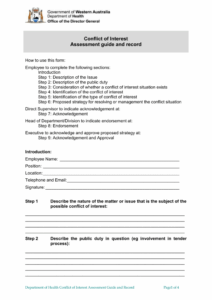
Developing a comprehensive conflict of interest assessment template is an incredibly powerful step towards fortifying your organization’s ethical foundations. This isn’t just a document; it’s a strategic tool designed to standardize the identification, evaluation, and management of potential conflicts. By providing a clear, step-by-step process, it removes ambiguity and ensures that every situation is handled with consistency, fairness, and an unwavering commitment to integrity. Think of it as your organization’s ethical compass, guiding decisions away from potential pitfalls.
A well-structured template should go beyond simple disclosure. It needs to prompt detailed information gathering, ask targeted questions that uncover the nature and extent of the potential conflict, and guide the user towards appropriate mitigation strategies. This systematic approach ensures that nothing is overlooked and that all relevant parties have a clear understanding of the situation and the steps being taken to resolve it. It helps transform an often-daunting task into a manageable and transparent process, fostering a culture where openness is not just encouraged but expected.
Implementing a robust conflict of interest assessment template brings numerous benefits. Firstly, it provides a consistent framework, ensuring that all individuals and situations are evaluated against the same criteria, thus promoting fairness and reducing the perception of bias. Secondly, it serves as a valuable record, demonstrating due diligence in the event of an audit or legal challenge. This documentation can be critical in proving that your organization took reasonable steps to prevent and manage conflicts. Finally, and perhaps most importantly, it empowers individuals to proactively address potential issues, knowing that there is a clear process to support them.
To make your template truly effective, involve key stakeholders in its creation or review process, including legal counsel, HR, and senior management. Ensure it’s easy to understand and use, providing clear instructions and examples. Regularly review and update the template to reflect changes in legislation, organizational structure, or emerging ethical considerations. A living document that evolves with your organization will be far more impactful than a static one.
Essential Elements for Your Conflict of Interest Assessment Template
- Declarer’s Identification: Name, department, role, and contact information.
- Nature of the Potential Conflict: A clear description of the situation or relationship.
- Involved Parties: Identification of all individuals or entities connected to the potential conflict.
- Relationship to Organizational Duties: Explanation of how the situation might intersect with their role or decision-making power.
- Assessment Questions: A series of questions to gauge the severity and likelihood of impact (e.g., “Could this create an advantage or disadvantage?”, “Does this involve financial gain?”).
- Proposed Mitigation Strategies: Space to outline how the conflict will be managed, e.g., recusal from decisions, divestment of interest, additional oversight.
- Reviewer’s Information: Name, role, and signature of the person assessing the declared conflict.
- Approval and Date: Dates and signatures indicating review, assessment, and approval of the mitigation plan.
Establishing a clear and accessible process for identifying and addressing conflicts of interest is not just about compliance; it’s about building an organization founded on trust and ethical behavior. By providing a structured framework, everyone gains the clarity needed to make sound judgments and uphold the highest standards of integrity.
Embracing this proactive stance ensures that your organization can navigate potential ethical challenges with confidence, fostering an environment where fairness and transparency are paramount. This commitment ultimately strengthens your reputation, safeguards your operations, and cultivates a workplace where ethical conduct is deeply ingrained in every decision.